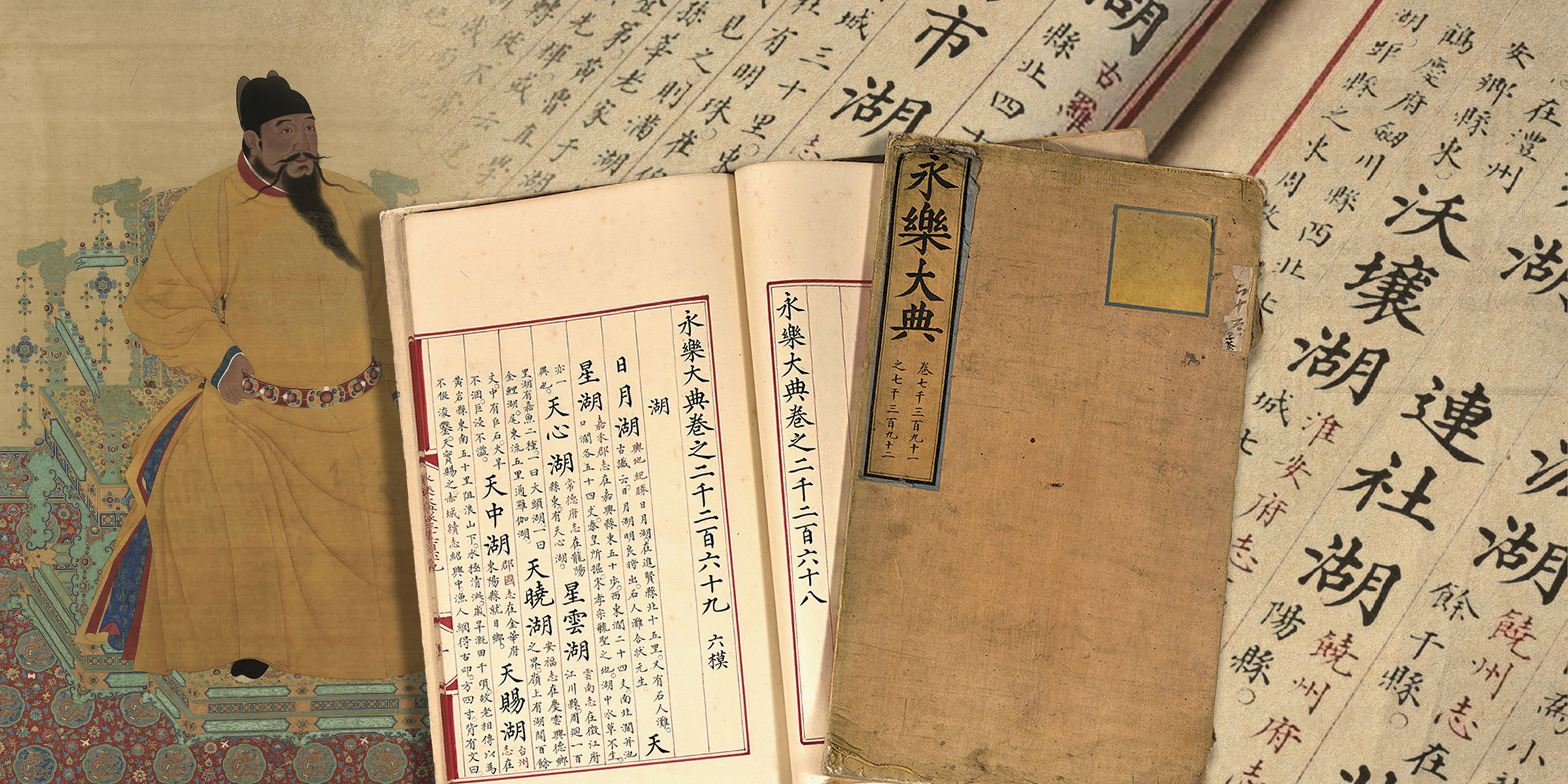
From Paris to Hangzhou: The $9m Quest to Return China’s Lost Encyclopedia
Over six centuries, the Yongle Encyclopedia has all but disappeared. Commissioned by the Ming emperor Zhu Di and compiled by more than 3,000 scholars, it once contained over 11,000 volumes on science, poetry, philosophy, medicine, and law. Today, less than 4% survives — fires and foreign invasions consumed the rest.
So when Weng Lianxi at Beijing’s Palace Museum received word in 2020 that two volumes would be auctioned in France, he was skeptical. Fakes were common, and with the pandemic grounding most international flights, he was unable to fly out to inspect them firsthand.
The researcher had only 39 JPEG images, a lifetime of handling ancient books, and a set of exacting criteria for the type of binding and paper used in the Ming dynasty (1368–1644). The photos checked every box, and the sellers were descendants of a French naval officer stationed in China in the late 1800s.
Convinced of their authenticity, Weng contacted businessman and book collector Jin Liang, who ultimately secured the volumes at auction for 8.12 million euros ($9.31 million), 1,600 times the starting price. This June, Jin donated them to the China National Archives of Publications and Culture (CNAPC).
Yet the journey of these “national treasures” from a Parisian attic, where they had sat unread for 140 years, to their new home in Hangzhou, capital of the eastern Zhejiang province, was anything but simple.
Cultural compendium
Weng first heard about the auction at Beaussant Lefèvre & Associés from a friend in June 2020, but he didn’t get his hopes up. “So many purported volumes of the Yongle Encyclopedia have emerged in recent years, and so few have been real,” he explains.
The original work was commissioned in 1403. After a first draft failed to meet his expectations, Zhu Di — aka the Yongle Emperor — ordered eminent scholars and calligraphers from across the realm to assemble and compile knowledge, “grouped by category and organized by rhyme.”
The final version approved in 1407 consisted of 22,877 manuscript rolls across 11,095 volumes, with between 370 million and 450 million Chinese characters, according to estimates by various academics. The book was first stored at the Ming Palace in Nanjing, which served as the nation’s capital from 1368 to 1421. It was later moved to the Forbidden City in Beijing, now the Palace Museum.
After a fire in 1557, the Jiajing Emperor ordered that the encyclopedia be reproduced, creating what’s known as the “Jiajing copy.” All known surviving volumes come from this edition.
The two copies were kept separately at the Forbidden City’s Belvedere of Embodying Benevolence and the nearby imperial archive, Huang Shi Cheng. When the Ming dynasty eventually fell in 1644, the belvedere was burned down, and the fate of the original became a mystery.
Between 1723 and 1735, the Jiajing copy was moved to the elite Hanlin Academy, just east of the Forbidden City. However, Qing dynasty inventory records from 1794 show that 1,154 volumes were already missing.
With the imperial court consumed by conflict with foreign powers as well as internal strife, fewer than 5,000 volumes remained by 1875. Within the next 25 years, nearly all of the Yongle Encyclopedia had been lost, largely because of corruption among Qing officials and looting by the invading Eight-Nation Alliance.
China today holds just 241 volumes, including the two purchased by Jin, with most housed at the National Library in Beijing.
Weng, a senior member of China’s Ancient Books Preservation and Conservation Association, says what first caught his attention in 2020 was the volumes’ provenance. “According to the collector, they were passed down through the family,” he says. “One ancestor was a French naval officer who had close connections with several Chinese officials in the 1870s and received many gifts, including these volumes.”
But what mattered most was determining their authenticity.
Having seen genuine excerpts from the ancient encyclopedia, he was confident he could easily spot a fake up close. But with many air routes suspended because of the pandemic, traveling to Paris wasn’t an option. He could only base his judgment on 39 photos taken by a friend in France.
First, Weng examined the volumes using conventional authentication criteria. The Yongle Encyclopedia uses wrapped-back binding, a traditional Chinese method in which a hard cover is added for protection after the pages are bound. The cover, made of high-quality xuan paper and silk, has a book label comprising blue silk under a smaller layer of yellow silk, and a manuscript roll label in the upper-right corner carrying indexing information.
Pages measure 50.3 centimeters by 30 centimeters, with a text frame of roughly 35.5 centimeters by 23.5 centimeters and hand-drawn border lines on all four sides.
“All these text frames had to be drawn by hand. To ensure speed and quality, line spacing was controlled using pinpricks,” Weng says, explaining that the compilers would pierce a stack of paper before drawing the lines.
In addition to the binders’ fine craftsmanship, another way to verify authenticity is through the display text. The Jiajing copy was written entirely in red and black ink, with the main text in Ming ministerial-style script.
To fix errors and omissions, the transcribers used a splicing technique that involved cutting out the erroneous section with a knife at a 45-degree angle and applying a patch, carefully aligning the paper’s fibers. Repairs are only visible when held up to the light.
Over about two weeks, Weng forensically examined each photo for clues and ultimately determined the volumes were real. Soon after, he called Jin, his longtime friend. “I told him there were no problems with the books. We just needed to prepare the money,” he recalls.
Pearls of wisdom
With the sale fast approaching, Jin, a textiles tycoon in his late 50s from Zhejiang’s Taizhou City, immediately set aside 100 million yuan ($14.9 million) of his personal finances. “That figure came from discussions with experts,” he says. “More importantly, it was all I could afford.”
On July 7, 2020, he used three phone lines to call the French auction house, just in case one got disconnected. The bidding began at 11:10 p.m. Beijing time, an hour later than scheduled because of the larger-than-expected turnout.
The starting price was just 5,000 euros. “We learned that despite taking China’s growing economic prosperity into account, the auctioneers expected a final sale price of only 200,000 euros. They obviously underestimated the value of these two volumes,” Jin says.
After the first round, bidding had already reached 4 million euros.
“Things started to slow down after it reached 5 million. Once it reached 6 million, I thought that was it, because people started to become a bit hesitant, and it finally ended at 6.4 million,” he says. With VAT and commission, the final price came to 8.12 million euros.
Jin immediately called his friend Weng to give him the good news.
“People and books are brought together by some kind of fate,” muses the entrepreneur. “When I was bidding for these volumes, if it hadn’t been for the transportation difficulties caused by the pandemic, many experts from around the world could have attended and recognized their authenticity at a glance. The government would also have arranged for experts to authenticate the volumes and applied for funding to make the purchases.”
However, purchasing them had been the easy part. Now Jin had that challenge of getting them back to China.
The first obstacle was France’s export review process for cultural property. Jin believes that, as the Chinese government was paying close attention to the matter, the French Ministry of Culture became “extra cautious.” The businessman had to apply twice to get an export permit.
When approval finally came almost five months later, China’s cultural and customs authorities and security transportation agencies drew up a plan for the volumes’ return. “We received considerable guidance from the National Library of China and the CNAPC,” Jin says. “We had to carefully consider the process to avoid any errors.”
In early 2021, employees from China Shipping Group accompanied the relics from the auction house’s storage facility in central Paris to the city’s Charles De Gaulle Airport, where they were loaded onto a China Eastern Airlines flight to Shanghai.
After clearing customs, the volumes were initially stored at the bonded warehouse in the Shanghai Free Trade Zone before being entrusted to Hangzhou’s Zhejiang Library for safekeeping.
On July 30, 2022, the CNAPC opened specialized storage facilities for ancient books in Beijing and Hangzhou, as well as Xi’an, capital of the northwestern Shaanxi province, and Guangzhou, capital of the southern Guangdong province. The new volumes of the Yongle Encyclopedia were deposited at the Hangzhou CNAPC soon after.
At the official donation ceremony in July this year, Jin expressed relief at having this weight lifted from his shoulders and joy at safely returning two “national treasures.”
“If they had remained in a private collection, their true value wouldn’t be fully realized,” he tells Jiefang Daily. “The CNAPC has done extensive research on these volumes. That’s why I donated them to the institution. … books are simply a vessel for research.”
Jin has donated 3,337 items to the Hangzhou CNAPC, but the Yongle Encyclopedia is “so important, so precious,” he says, describing it like a giant gene bank preserving thousands of years of Chinese civilization.
In terms of content, this monumental work contains a vast number of lost texts from the Song (960–1279) and Yuan (1279–1368) dynasties, and informs researchers on manuscript production in the Ming era.
“Unlike the ‘Complete Library of the Four Treasuries’ compiled in the Qing dynasty, which strictly adhered to Confucian principles, teasing out all the materials that were irrelevant or fell outside the content, the Yongle Encyclopedia showed far less parochialism,” says Zhang Pu, deputy director of the Hangzhou CNAPC.
The Ming-dynasty book provides a wealth of firsthand materials for research, everything from a prescription by a physician in the central Hunan province to detailed rules for the game pitch-pot.
“There are just so many things to look into,” says Zhang, whose team has already published eight theses on the new volumes and discovered 22 previously unknown poems. “Every one is like a pearl left behind by history.”
Reported by Li Chuyue.
A version of this article originally appeared in Original (Jiefang Daily). It has been translated and edited for brevity and clarity, and is republished here with permission.
Translator: Li Yu; editors: Wang Juyi and Hao Qibao.
(Header image: Visuals from Beaussant Lefèvre & Associés and the Taipei Palace Museum, reedited by Fu Xiaofan/Sixth Tone)